Monday, July 16, 2012

Water still a Big Problem in Rural Areas in Tanzania

Water problem has of late become of great concern to many Areas, Tanzania is blessed with forests, water, minerals, fish, wildlife, and fertile soils. Such resources are of paramount importance to the existence of ecosystems, which range from wetlands to highlands or mountain ecosystems. 
 But freshwater especially human beings.  , without a doubt, is the most valuable resource for all living organisms in Tanzania – The fresh water is mostly available in some Urban areas, Instade of Rural areas. About 85% of the local population acquires its water through the Modern water sewage facilities.


At a other women dressed up in colorful cloths called ''Kanga'' or vitenge in Swahili are seen along water system in pairs frequently along the streets in the peri-urban areas. The maids and women carry equally colourful twenty litre plastic buckets on their heads. The buckets contain water to drink in the wake of acute water shortages in the areas. It means that water quantity for bathing is more limited since it is of less importance compared to drinking and cooking.

 As a result, people have to find alternative to bathing in order to ensure that they do not produce foul smell especially where the means of transport is the City buses in which passengers are crowded. Bus conductors instruct students to sit on each others' laps in order to fill up every inch of the space in the buses.


People waiting for water in one of the drainage system, Its take a long time to get it
for there daily consumption

Women do most of the work, and there is not enough water. Here, the girls return from the community tap with water for the evening, after finishing class for the day


 Relative to other African countries, ................ Morogoro Urban Water Supply Authority, while 10% fetch water directly from steams and local wells, and a final 5% have independent means for acquiring water.  Most of these sources provide potable water, although in recent years there have been outbreaks of water resource, also known as snail fever, due to an abundance of stagnant freshwater in some places.  There is a need to strike balance between the demand for freshwater in the region, and the amount that can be sustainably supplied by regional sources.
 In Tanzania today, the water situation is not fixed nor nearly perfect, but the government and the people know how important it is to have access to sanitary options and continue to work towards that goal.
While Tanzanians look up to the government to provide solutions to their water problems, they too have a role to play in protecting water sources because water is life. The government should also plan for realistic theme that meets the needs at the moment; as the theme given this year is ideal for ensuring availability of clean and safe water neither to cities (urban areas) nor the marginalized rural areas.
Tanzania case study RamaOn average, women and children spend over two hours a day collecting water, and up to seven hours in remote areas.

20,000 children die before the age of five each year in Tanzania due to diarrhoeal diseases.


“The average woman in Tanzania will walk three hours a day for just 40 liters of water. When women and children are doing these walks, they’re not in school, they’re not running businesses, and they’re not teaching their children,

“The average woman in Tanzania will walk three hours a day for just 40 liters of water. When women and children are doing these walks, they’re not in school, they’re not running businesses, and they’re not teaching their children,

Sunday, July 15, 2012

KWAITO DANCE...

 Dont call my number (facebook),bumpa side to side,zombooo zombo maweee,lento..this are among the kwaito tracks when played at night clubs in my country you would see people start queuing to dance the shuffle style which is well known as kwaito..please learn more about kwaito and enjoy...
Kwaito is a music genre that emerged in Johannesburg, South Africa, during the 1990s. It is a variant of house music featuring the use of African sounds and samples. Typically at a slower tempo range than other styles of house music, Kwaito often contains catchy melodic and percussive loop samples, deep bass lines, and vocals. Although bearing similarities to hip hop music, a distinctive feature of Kwaito is the manner in which the lyrics are sung, rapped and shouted. American producer Diplo has described Kwaito as "slowed-down garage music," most popular among the black youth of South Africa.


The word kwaito is an Isicamtho term from the Gauteng townships and encompasses styles that range from guz, d'gong, and isgubhu to swaito. The word originates from the Afrikaans kwaai, which traditionally means strict or angry, although in more common and contemporary use the word is a loose translation of the English term cool. Kwaito led a post-Apartheid township subculture into the mainstream. Despite the fact that the Afrikaans language is associated with the apartheid regime and racial oppression, Afrikaans words are often drawn into the Isicamtho vocabulary, reshaped and used in a related or new context. M'du Masilela, a pioneering Kwaito artist, said, "When house music got popular, people from the ghetto called it Kwaito after the Afrikaans slang word kwai , meaning those house tracks were hot, that they were kicking." Another Isicamtho word derived from the Afrikaans word kwaai is amakwaitosi, which means gangster. The popular Kwaito artist and producer Arthur Mafokate describes the relationship between Kwaito and gangsterism as music revolving around ghetto life.

                                                              Tofu Tofu Dancers
 There are two artists who claim to be the kwaito originators.
One is M'du, who claims he was the first to mix BubbleGum with House from the UK and the US back in the 1980s. The other is Arthur Mafokate, who is also credited by some as the king of Kwaito, including himself as he wrote in a two-page piece called "Am I the king of Kwaito?"
Mafokate's claim to fame is due to importance of his 1993 song "Don't call me Kaffir", which put the Kwaito genre on the charts.
The first official Kwaito song played in South Africa, done by Arthur, with the usage of one of the most degrading words that white colonialists would call black Africans, Kaffir is the Arabic word for ‘non-believer’ or a ‘heathen’ which is the word that Afrikaans described the natives with. In his song, Arthur demands the Boss, ‘Nee baas’ (No Boss), ‘don’t call me a Kaffir...;
The song, written in several forms, talked about how apartheid will not just go away overnight but change is coming. His groundwork has created an avenue for South African youth to channel their anger, talent and their voice, an outlet that they can call their own.[citation needed] Through this music the youth were able to express their feelings of oppression. One of the originators of Kwaito, DJ and producer Oscar waRona of B.O.P, has said that it started out as house with small additions to that genre such as congas and other instruments. Arthur Mafokate's "major" hit "Don't call me a Kaffir" was about white people in South Africa using that word to refer to the black people. The song was made possible because of the post-apartheid system, but never would have been recognized or accepted in the apartheid times.
Tofo Tofo Beyonce African Dancers Meet Tofo Tofo: The Beyonce African Dancers
tofo tofo dancing kwaito


 "who run the world ,while i was watching this legit video for the first time i did ask myself where did Beyonce get this massive dancers??the answer came after i visited youtube.
You know the part where Beyonce does the  shoulder-work in gorilla fur vest.  I think the whole video should just have included more incredible dance moves with members of Tofo Tofo, the Mozambican kwaito dance group in the video. There are three members in the group, but only two appeared in the video. Although we know the group is called Tofo Tofo,  the actual names of the dancers haven’t been published.
Beyonce and her team discovered Tofo Tofo on Youtube, and tracked them down in Mozambique to be in her video. In order to find the dancers Beyonce’s team had to enlist the help of the Mozambique embassy.


“We had seen something on YouTube; we had seen these three guys from Africa, this Mozambique African dance troupe … we were like, ‘Wow, this is an amazing movement.’ [...] And that movement has always been in the back of our head for the last year. From there, we talked about a lot of concepts.”
“We say, ‘Share the light, you sparkle brighter,’ and we share our light with a lot of new, creative people. I feel like we really nailed it and, again, my hats off to the Tofo Tofo guys [from Africa], ’cause none of us could imitate that. We had to bring them around to learn that [move], which is really, really interesting. They had such a great vocabulary of movement.”
“Those two dancers not only helped shape the moves in the video, but also moved BeyoncĂ©. That was probably one of the most beautiful experiences for BeyoncĂ©. They were so humbled. [...] I’m pretty sure we’ll see them again. It was magical.” [Read more]
According to Gaston, it took about two months to track down the dancers due to them living in remote areas in their home country of Mozambique. Beyonce wanted them to be a part of her video so bad that they had to get the Embassy’s help to find them! What a blessing

Kwaito is a form of self-expression and a way of life—it is the way many South Africans dress, speak, and dance. It is a street style as lifestyle, where the music reflects life in the townships, much the same way hip hop reflects life in the American ghetto. As a result, the growth of kwaito in post-Apartheid South Africa has changed not only the music scene but many urban cultural aspects as well. The fashion industry has boomed all over the country, with urban apparel designers such as Stoned Cherrie, Loxion Kulca, and Sun Godd'ess setting trends based on those trends emphasized by kwaito artists. YFM, a youth radio station launched in Gauteng in 1997, has become the most widely listened to urban youth radio station in the country, adhering to the principle of giving the youth the license to create its own identity. After having been rejected by major record labels of the apartheid era, many independent kwaito labels emerged such as Kalawa, Triple 9, and Mdu Music. These labels produced myriad employment opportunities for young Black producers, engineers, and attorneys in the music industry and, more importantly, has provided young Black people with a source of financial gain and dignity. Furthermore, kwaito has strengthened social integration. While promoting South Africa internationally through successful overseas tours by artists such as Bongo Maffin, Tkzee, and Boomshaka, kwaito has gained a huge following with older Black people who grew up on protest songs, as demonstrated by President Thabo Mbeki when he performed the S'guqa dance with kwaito artist Mzekezeke during his song "S’guqa ngamadolo" at the 2003 Freedom day celebrations. This marked a huge change in the way people envisioned kwaito, engendering a more widespread commercial audience.
                                                                     Dj Cleo
Famous kwaito DJs—such as DJ Oskido, DJ Rudeboy Paul, DJ Mjava, and DJ Cleo—are well known for producing many of the big Hip-Hop South African Artists. Many of these DJ's in Kwaito release their own albums after producing other famous musicians in South Africa. The majority of them do not make much money but have very high hopes for the future. DJ Cleo said "All I need is that one chance produce just that one song for any rapper, Jay-Z, Jah Rule, 50 Cents, whatever. And I will kill it. It will become a hit worldwide. Try me. Whoever you're going to play this to, get a hold of me." Very similar to other genres of music, Kwaito wants to stay original and stick close to the roots. DJ cleo is considered one who tries to stay careful not to abandon his kwaito fan base in a flash because many Kwaito fans take abandoning the original tunes as offensive and turning your back on the Kwaito meaning.
CRITICS:
Despite what it has brought to the country, kwaito faces critics. The kwaito music industry is viewed as male-dominated, especially in management. There are few successful female artists. Lebo Mathosa, who was one of kwaito’s most famous female artists and a member of Boom Shaka, noted that it is "difficult because every producer that you meet in our country is male there isn’t even one female producer that you could say ok I like that record that is produced by so and so." Others accuse kwaito as being talentless, commercialized and mass-produced, consisting of sexually-driven lyrics and dances.


Friday, July 13, 2012

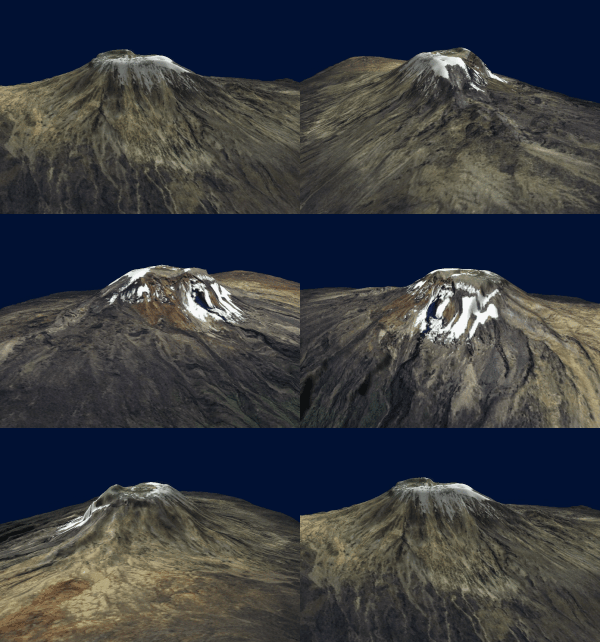
WHY I LOVE MOUNT KILIMANJARO...??

It all began as a joke where i and my friends decided to climb this beautiful mountain,it had always been a dream that i had but it finally went to reality ,since i asked for it and believed i could climb and finally it happened.
 During my climb i learned a lot ..and i thought why shouldn't i share this marvelous story with you.
beginning the journey with my friends
Kilimanjaro is composed of three distinct volcanic cones: Kibo 5,895 m (19,341 ft); Mawenzi 5,149 m (16,893 ft); and Shira 3,962 m (13,000 ft). Uhuru Peak is the highest summit on Kibo's crater rim.
Kilimanjaro is a giant stratovolcano that began forming a million years ago, when lava spilled from the Rift Valley zone. Two of its three peaks, Mawenzi and Shira, are extinct while Kibo (the highest peak) is dormant and could erupt again. The last major eruption has been dated to 360,000 years ago, while the most recent activity was recorded just 200 years ago.
Although it is dormant, Kibo has fumaroles that emit gas in the crater. Scientists concluded in 2003 that molten magma is just 400 m (1,310 ft) below the summit crater. Several collapses and landslides have occurred on Kibo in the past, one creating the area known as the Western Breach.

ORIGIN OF THE NAME KILIMANJARO:
It is unknown where the name Kilimanjaro originates, but a number of theories exist. European explorers had adopted the name by 1860 and reported that it was its Swahili name, with Kilimanjaro breaking into Kilima (Swahili for "hill, little mountain") and Njaro, whose supposed origin varies according to the theories—according to some it is an ancient Swahili word for white or for shining, or for the non-Swahili origin, a word from the Kichagga language, the word jaro meaning "caravan". The problem with all these is that they cannot explain why the diminutive kilima is used instead of the proper word for mountain, mlima. The name might be a local joke, referring to the "little hill of the Njaro" being the biggest mountain on the African continent, since this is a nearby town, and guides recount that it is the Hill of the Njaro people. A different approach is to assume that it comes from the Kichagga kilmanare or kileajao meaning "which defeats the bird/leopard/caravan". However this theory cannot explain the fact that Kilimanjaro was never used in Kichagga before in Europe in the mid-19th century.
An alternative theory is as follows: On November 10, 1848, the German missionary Rebmann wrote in his diary, "This morning we discerned the Mountains of Jagga more distinctly than ever." Jagga was the pronunciation of Chagga by Europeans. Kilimanjaro may also be the European pronunciation of the Chagga phrase that "Kile-lema-irho", meaning "we failed to climb it" in Kiuru, Kioldimoshi, Kimarangu, Kivunjo, Kikibosho, Kimachame and Kirombo, Kichagga in general. If so, name itself, Kile-lema-irho/Kilimanjaro, would have been the Chagga way of explaining to kyasaka (newcomers) when they asked about the shining mountain top of Kibo and Mawenzi Peak. Kibo peak is more visible from the Kibosho Area, and Mawenzi from Maranu.
kibo peak


ROUTES

There are six official trekking routes by which to climb Mt Kilimanjaro, namely: Marangu, Rongai, Lemosho, Shira, Umbwe and Machame. Of all the routes, Machame is by far the most scenic albeit steeper route up the mountain, which can be done in six or seven days. The Rongai is the easiest and least scenic of all camping routes with the most difficult summit night and the Marangu is also relatively easy, but accommodation is in shared huts with all other climbers. As a result, this route tends to be very busy, and ascent and descent routes are the same.
People who wish to trek to the summit of Kilimanjaro are advised to undertake appropriate research and ensure that they are both properly equipped and physically capable. Though the climb is technically not as challenging as when climbing the high peaks of the Himalayas or Andes, the high elevation, low temperature, and occasional high winds make this a difficult and dangerous trek. Acclimatisation is essential, and even then most experienced trekkers suffer some degree of altitude sickness. Kilimanjaro summit is well above the altitude at which high altitude pulmonary edema (HAPE), or high altitude cerebral edema (HACE) can occur. All trekkers will suffer considerable discomfort, typically shortage of breath, hypothermia and headaches.
High-altitude climbing clubs—citing safe ascent rate suggestions offered by organisations such as the Royal Geographical Society—have criticised the Tanzanian authorities for charging fees for each day spent on the mountain. It was once argued that this fee structure encouraged trekkers to climb rapidly to save time and money, while proper acclimatisation demands that delays are built in to any high climb. However, in response to this accusation, Tanzania National Parks Authority several years ago mandated minimum climb durations for each route. These regulations prohibit climbs of fewer than five days on the Marangu Route, and ensure a minimum of six days for the other five sanctioned routes. These minimums—particularly in the case of Marangu, which ostensibly allows that Uhuru Peak (5,895m) can be reached from a starting elevation at 1,860m within 72 hours of beginning the ascent—are reckoned by most alpinists to allow an ascent rate that will usually result in the climber failing to acclimatize adequately, by the time that Kibo Huts are reached; the launch base from which the summit is assaulted. Consequently, the incidence of Acute Mountain Sickness (AMS) is widely deemed to be unacceptably high on Kilimanjaro, with high volumes of fit young people succumbing to the condition, having opted for a relatively rapid ascent. As a general rule, it is far safer (and more enjoyable) to avoid altitude sickness by planning a sensible itinerary that allows for gradual acclimatisation to high elevation as one ascends. Operations that typically see in excess of a thousand climbers summitting annually and are best placed to identify such patterns, usually posit that an optimal climb length should last around seven to eight days.


look how tired we were,anyway we were about 23 of us but few managed to reach Kibo peak ,the journey can be tiresome but thanks to the well educated tour guides and supporting porters who are dedicated to do their jobs. 

WHAT SHOCKS ME ??
Disappearance of ice...
The period from 1912 to present has witnessed the disappearance of more than 80% of the ice cover on Kilimanjaro. From 1912 to 1953 there was ~1% annual loss, while 1989–2007 saw ~2.5% annual loss. Of the ice cover still present in 2000, 26% had disappeared by 2007. While the current shrinking and thinning of Kilimanjaro's ice fields appears to be unique within its almost twelve millennium history, it is contemporaneous with widespread glacier retreat in mid-to-low latitudes across the globe. At the current rate, Kilimanjaro is expected to become ice-free some time between 2022 and 2033.

UHURU PEAK


  wake up ,wake up tour guides waking us up at midnight ,that's when we all have to dress up in order for us to vacate kibo huts and head for the Uhuru peak,very cold indeed.
we started our journey to the peak ,i remember we were arranged in a Que..no body talked ,we walked for about two hours heading to the peak,suddenly some people started quitting and the guides had to give them an escort back.we moved on while each stop we made to rest people would require to turn back .few of us that had courage we continued to the last point. Finally we saw the peak...but what bored us is how the guides encouraged us..which its good at some point but i hated when they told us to not worry we almost there,they repeated this about million times but we still had many kilometers to cover.
special thanks to : TANAPA , our head of guards Dastan and all others that helped us reach our dream.
FREE ADVICE:VISIT THE WILDERNESS IN TANZANIA AND ENJOY
KILIMANJARO SHOULD BE CONCURRED NOT TO BE A PHOBIA.

Wednesday, July 11, 2012

STREET CHILDREN IN TANZANIA..

There are an estimated 437,500 street children in Tanzania. Many live on the street because of the violence and abuse they suffered at home. Many more face daily abuse on the streets from the police, sex tourists and even each other. CSC is raising money to provide grants for its partners on the ground in Tanzania, so that they can ensure that work being done to prevent violence against street children is effective.
What is the issue, problem, or challenge?
The UN Convention on the Rights of the Child states specifically that children have the ‘right to protection from all forms of violence’ yet CSC's report 'State of the World's Street Children: Violence' highlighted the large role that violence plays in driving children to the street and a recent UNICEF backed report found that 75% of Tanzanian youth stated they had experienced physical violence and 25% stated they had experienced emotional abuse during their childhoods.
It is imperative that street children are given a voice and listened to when creating policies to reduce violence against them. Follow up studies must be undertaken directly with street children to ensure that recommendations from past studies are being implemented. The Consortium for Street Children is raising money in order to be able to provide grants for our partners on the ground in Tanzania so that they may conduct these follow up studies.


What is life like on the streets?

Boys and girls who live and work on the streets are vulnerable to wide and extreme violations of their rights. They have difficulties accessing basic services and are verbally, physically and sexually abused. Few trust adults. Many perpetuate abuse on their weaker peers. Although these boys and girls may have a range of skills related to survival and informal income generation, these strengths remain unarticulated and unrecognised by mainstream society. This combined with the fact that few of them have benefited from sustained formal education means that these children generally find it very difficult to earn money legally. Faced with this situation, many are forced into crime and confrontation with the general public. Significant numbers of these boys and girls seek temporary relief from their situation through substance abuse. They become trapped in a cycle of poverty, violence and abuse. They are socially excluded, highly visible, mobile and increasing in number. They are unable to access basic services - including school - which generates further problems and demands on already overstretched social services and the criminal justice system. As these children age, they run increasing risk of HIV/AIDS and conflict with the law.


What causes children to run to the streets?

A child's departure from home is seldom sudden, despite common conceptions to the contrary. Rather, it usually takes the form of a series of steps in which individuals find out more about the urban environment, investigate work opportunities and make contact with homeless children. Similarly, the factor prompting departure is less commonly a single event than is often thought - rather, it is often a combination of stressors on different causal levels, as suggested in a recent ILO report:
  • Immediate: the reason why a child may leave home and go to work or live on the streets could be a sudden drop in family income; loss of support from an adult family member due to illness, death or abandonment; or an episode of domestic violence.
  • Underlying: chronic impoverishment, cultural expectations (such as the idea that a boy should go to work on the streets as soon as he is able), desire for consumer goods, or the lure of the city.
  • Structural: factors such as development shocks, structural adjustment, regional inequalities and social exclusion. 


 This multiplicity of levels means that few children are able to perceive all the circumstances that contributed to their decision to leave home. The reasons given by a child on the day of leaving home may anyway be quite different to those they offer three months later after s/he has rationalised his/her home situation and their actions.


Case Study: Adam
Adam says "It hurts me when I remember. When I was on the streets I could not sleep because I did not trust anyone and was scared because I saw the way other kids were being treated. One night a boy, Isenga, was crying. I saw the man called Koko raping him. I decided to run from there. I also saw the dead body of the street boy called Fogo. The other older boys killed him in a fight over money. I did not believe that there are human beings who can behave like animals. It hurts me when I remember."
These children are Tanzanian Future lets do something ,lets support them .Global giving has raised $620 remaining $49,380 visit there site and learn more on how you can help this children.
LET OUR VOICES BE HEARD AND ACTIONS BE SEEN.

WHAT KILLED YASEER ARAFAT???POISON??

Mohammed Yasser Abdel Rahman Abdel Raouf Arafat al-Qudwa al-Husseini a leader that i have always admired,one who could stand for his people .He was Chairman of the Palestine Liberation Organization (PLO), President of the Palestinian National Authority (PNA), and leader of the Fatah political party, which he founded in 1959. Arafat spent much of his life fighting against Israel in the name of Palestinian self-determination. Originally opposed to Israel's existence, he modified his position in 1988 when he accepted UN Security Council Resolution 242. Arafat and his movement operated from several Arab countries. In the late 1960s and early 1970s, Fatah faced off with Jordan in a brief civil war. Forced out of Jordan and into Lebanon, Arafat and Fatah were major targets of Israel's 1978 and 1982 invasions of that country.
It was a scene that riveted the world for weeks: The ailing Yasser Arafat, first besieged by Israeli tanks in his Ramallah compound, then shuttled to Paris, where he spent his final days undergoing a barrage of medical tests in a French military hospital.

Eight years after his death, it remains a mystery exactly what killed the longtime Palestinian leader. Tests conducted in Paris found no obvious traces of poison in Arafat’s system. Rumors abound about what might have killed him – cancer, cirrhosis of the liver, even allegations that he was infected with HIV.

A nine-month investigation by Al Jazeera has revealed that none of those rumors were true: Arafat was in good health until he suddenly fell ill on October 12, 2004.
Tests have revealed that Arafat’s final personal belongings – his clothes, his toothbrush, even his iconic kaffiyeh – contained abnormal levels of polonium, a rare, highly radioactive element. Those personal effects, which were analysed at the Institut de Radiophysique in Lausanne, Switzerland, were variously stained with Arafat’s blood, sweat, saliva and urine. The tests carried out on those samples suggested that there was a high level of polonium inside his body when he died.
The findings have led Suha Arafat, his widow, to ask the Palestinian Authority to exhume her late husband’s body from its grave in Ramallah.
But a conclusive finding that Arafat was poisoned with polonium would not explain who killed him. It is a difficult element to produce, though – it requires a nuclear reactor – and the signature of the polonium in Arafat’s bones could provide some insight about its origin.

                                              world's top forensic pathologists analysing Arafats cloths
 Israel refused Arafat's wish to be buried near the Al-Aqsa Mosque or anywhere in Jerusalem, citing widespread security concerns. Israel also feared that his burial would strengthen Palestinian claims to East Jerusalem. Israeli cabinet minister Tommy Lapid stated that "Jerusalem is the burial place of Jewish kings, not of Arab terrorists". Following the Cairo procession, Arafat was "temporarily" buried within the Mukataa in Ramallah; tens of thousands of Palestinians attended the ceremony.Also attending were at least one Israeli peace activist (Uri Avnery, head of Gush Shalom) and a Christian minister. Arafat was buried in a stone, rather than wooden coffin, and Palestinian spokesman Saeb Erekat said that Arafat would be reburied in East Jerusalem following the establishment of a Palestinian state. After Sheikh Taissir Tamimi discovered that Arafat was buried improperly and in a coffin—which is not in accordance with Islamic law—Arafat was reburied on the morning of 13 November at around 3:00 am. On 10 November 2007, prior to the third anniversary of Arafat's death, Palestinian President Mahmoud Abbas unveiled a mausoleum for Arafat near his tomb in commemoration of him.
Arafats temporarily tomb


 MAY HIS SOUL REST IN PEACE...

sources :Al jazeera english

Tuesday, July 10, 2012

GOD PARTICLE DISCOVERED???

While i was busy viewing different sites i came across this...i decided to share this with you since i think its important for everyone to know..
One of the most important discoveries in particle physics of the last 25 years has possibly just been made by experimentalists at CERN, the giant laboratory just outside of Geneva on the border of Switzerland and France. Scientists there think that they have discovered the Higgs field, also nicknamed the "God particle" by Nobel laureate Leon Lederman who wrote a book with that title. If the result is verified, the Higgs will have a mass about 125 times the mass of the proton, making it as heavy as a medium-sized nucleus, and it will "fill in" the last missing piece of a puzzle involving the solution of one of the great outstanding problems in physics of the 20th century: the origin of all mass. If the properties of the Higgs are confirmed, the picture of fundamental particle forces will have been completed. That picture is known as The Standard Model.
     The Standard Model of particle physics provides a description of microscopic matter and their fundamental interactions. All matter is comprised of quarks and leptons. Three quarks bind to form the proton and neutron. The neutrons and protons stick together to form nuclei – the tiny, heavy central "hearts" of atoms. Leptons appear in nature in two types: electrically charged and neutral. Neutral leptons are called neutrinos and hardly interact with matter at all. There are three known charged leptons, the lightest of which is the electron. Electrons, which are negatively charged, are attracted to nuclei, which are positively charged, to form atoms. A good pictorial representation of an atom is a cloud of electrons swarming around a tiny nucleus, much the way bees might swarm around a queen who has left her hive. Since atoms make up everything in the world, quarks and leptons are the fundamental building blocks of nature.
     There are three fundamental forces. The most familiar is gravity, which holds humans and other objects to the Earth, makes the Moon go around the Earth thereby leading to tides, lunar phases and eclipses, and causes the Earth to orbit the Sun thereby leading to seasons. Gravity is generated by objects with mass. But because gravity is such a weak force, only bodies of huge mass, such as the Earth and Sun, create a significant effect. In the subatomic world, where protons, neutrons and electrons are extremely light, gravity plays no role.
     The second fundamental force is a combination of three forces previously thought to be independent of one another: magnetism, the electric force and the weak subnuclear interaction. The unification of the electric and magnetic forces was achieved in the 19th century, leading to electromagnetism. The electromagnetic force is the source for all macroscopic forces except those created by gravity. Friction, spring forces, air pressure, the forces in collisions, and so on, originate from the electromagnetic force. The weak subnuclear interaction is responsible for certain decays of nuclei and plays a role in generating the energy of the Sun and other stars in their cores. As its name implies, it operates at distances smaller than a nucleus and it is very weak. For this reason, it is difficult to observe. At the end of the 1960's, a theory was proposed that unified the weak subnuclear force with electromagnetism. Experiments in the 1970's and 1980's confirmed the electroweak theory. In 1979, Steven Weinberg, Sheldon Glashow and Abdus Salam received the Nobel Prize in physics for unifying the weak subnuclear interaction with electromagnetism.
     The third fundamental force is called the strong nuclear force. It binds three quarks together to from the proton and the neutron. It is also responsible for causing protons and neutrons to stick to one another in a nucleus.
     One of the key ideas in physics is that the basic particle forces are generated through the exchange of vector gauge bosons. These are particles that spin with one fundamental unit and incorporate an enormous amount of symmetry. The electromagnetic force is generated when charged particles exchange photons (spin one particles of "light"), the weak subnuclear interactions are generated by exchanging heavy vector bosons known as W's and Z, while the strong force is produced by eight gluons.
     The fundamental constituents – quarks and leptons – along with the two fundamental particle interactions – the electroweak interaction and the strong nuclear force constitute The Standard Model of particle physics. Gravity has not been yet incorporated because a good quantum theory of gravitation is not available.
     It would seem that scientists know everything there is to know about microscopic matter and its interactions. However, one aspect of The Standard Model has remained a mystery: the mechanism that produces fundamental mass. The weak subnuclear interactions are feeble and short-ranged because the W and Z have very heavy masses of 90 - 100 times the mass of a proton. In contrast, the photon is massless. It is this great mass difference that makes electromagnetism so different from the weak subnuclear force. How are masses for the W and Z created? During the past 30 years, theorists have proposed various mechanisms, of which only experiment can decide which is correct. One way to give masses to the W and Z is to use particles known as Higgs fields. Four such particles are needed. Three are absorbed by the W and Z and one is left over. In this mechanism, there should be one spin zero, electrically neutral particle observed in nature. This is the "God particle," the Higgs particle. The potential break-through discovery at CERN suggests that W and Z masses are created by the Higgs mechanism. The positively charged W, the negatively charged W and the neutral Z obtain mass by respectively absorbing positively charged, negatively charged and neutral Higgses.
     The Higgs field also has the ability to generate masses for the quarks and leptons. Thus, if the expected properties of the Higgs field are confirmed, then the origin of all mass will be understood.

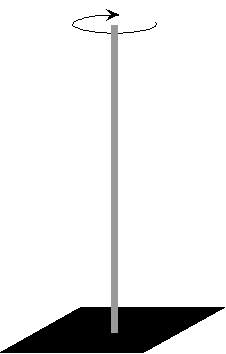
     The generation of mass proceeds through a process known as spontaneous symmetry breaking. An object has symmetry if rotating it does not change its appearance. For example, if a rod is rotated as indicated in Figure A, its appearance is unchanged. A sphere has even more symmetry than a rod because a sphere can be rotated in many ways without changing its shape.


symmetry

Figure A
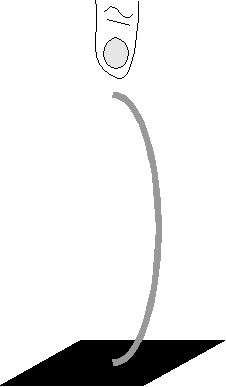
     Spontaneous symmetry breaking occurs when a system or object naturally looses its rotational invariance. Suppose pressure is exerted on the rod; say by pushing on it with a finger. Then, if sufficient force is applied, the rod will buckle. See Figure B. When a buckled rod is rotated, one can tell that it has been rotated; thus, the symmetry has been broken.


broken symmetry

Figure B
     By the way, if the force is exerted exactly along the axis of the rod from the top, one might think that it is impossible for the rod to buckle in a particular direction. However, the buckling WILL occur but the direction is unpredictable. This is a feature of spontaneous symmetry breaking. The breaking takes place but one does not know in which direction.

     The Higgs field thus acts as the finger in Figure B, applying pressure to the system to cause it to buckle and loose its symmetry. It is a deep result of quantum field theory that when this happens that the W and Z, which are messengers of the symmetries broken by the Higgs, acquire masses. In other words, without spontaneous symmetry breaking the W and Z would be massless.
     The Higgs field produces masses for the quarks and the electrically charged leptons through its interactions with these fields. These masses are proportional to the strength with which the Higgs couples to the particles. Because the Higgs interacts most strongly with the top quark, the top quark weighs the most (about 200 times the mass of a proton). The electron interacts very weakly with the Higgs and that is why it is the lightest particle (about 2000 times lighter than a proton). Physicists do not understand why the Higgs couplings differ so greatly, so that even if the CERN experiment is confirmed and the Higgs mechanism is realized, certain features of the Standard Model will remain a mystery.
      So if one of the most important scientific discoveries has been made, why has there been so little news about it? The answer is that because of its great importance, experimentalists must be sure of the result before announcing it. There are four experimental detectors at CERN. Of these four, only Aleph is seeing convincing evidence of Higgs production. That detector sees three Higgs-candidate events. Another detector, Delphi, also thinks that it has produced one Higgs in a single positron-electron collision. Although Aleph states that the Higgs has been seen with better than 99% confidence, no strong claims can be made with so few events. CERN has decided to run its LEP experiment an extra month or so to try to produce more Higgs particles. If successful, an important announcement on the Higgs discovery will be made near the end of this year. 

Imagine you’re at a Hollywood party. The crowd is rather thick, and evenly distributed around the room, chatting. When the big star arrives, the people nearest the door gather around her. As she moves through the party, she attracts the people closest to her, and those she moves away from return to their other conversations. By gathering a fawning cluster of people around her, she’s gained momentum, an indication of mass. She’s harder to slow down than she would be without the crowd. Once she’s stopped, it’s harder to get her going again.


RACISM IN EUROPEAN FOOTBALL..

After racist chants in stadiums in Italy and Spain Final brought African players to tears, the European Union and soccer's governing body are planning to get tougher on soccer's major problem.
On soccer pitches across Belgium, players will wear a black and white stripe on their faces. In Italy, an anti-racism banner will be unveiled before the opening whistle of every top Italian league and Italian Cup match.
The measures, organized by the Belgian and Italian leagues, follow another shameful time of racism in European soccer.  Messina's Ivory Coast defender Marc Zoro threatened to walk off the field after fans of his team's opponents, Inter Milan, repeatedly hurled racial epithets at him. Two Espanyol of Barcelona players, the Cameroon goalkeeper Carlos Kameni and the Brazilian midfielder Fredson, were subjected to racist chants in Madrid by fans of opponent Atletico Madrid.
From fines to bans
Though hardly a new problem in the Spanish and Italian leagues, both European soccer's governing body as well as the European Parliament have promised to throw the book at violators and disperse the dark cloud hanging over European soccer.
"We are prepared to implement the necessary sanctions, from fines and closure of stadiums, and even to not allow teams to participate in competitions," said Per Ravn Omdal, the vice president of UEFA.
EU legislators are proposing a law that could stop games in which players are racially abused as well as punish the guilty clubs and national federations. Persistent offenders will be permanently removed from competition, should the new law go through. If more than half of the EU parliament signs the declaration, it will become a resolution with the possibility of becoming law.
Mario Baloteli


Player, in tears, tries to stop match
The strong measures came about after the Zoro incident created headlines around the world. In the 66th minute of his team's match against Inter Milan, he picked up the ball, planning to hand it to the fourth referee official as he walked off the pitch. Inter Milan stars Adriano, a Brazilian, and Nigerian forward Obafemi Martins, intervened. They pleaded with their fans to stop and convinced Zoro, who was in tears, to continue playing.
Omdal would like to see referees take more initiative in suspending or stopping matches marred by racist chants or taunts.
"Referees will be given the necessary power to abandon or cancel matches if necessary," he said. "We need referees and match officials to be tough on this issue. If they have been asleep then they need to wake up."
Marco Zoro
Soccer's racism problem nothing new
European soccer has paid particularly close attention to racism in recent years after several high-profile incidents.
World governing body FIFA fined the Spanish Football Association 100,000 Swiss francs ($87,340) after Spanish fans directed racist chants at black English players Thierry Henry and Shaun Wright-Phillips during a match between the two national teams in November 2004. The Spanish FA fined national team coach Luis Aragones 3,000 euros for racist remarks he made about Henry to his team, a figure that was slammed by anti-racism campaigners as far too low.
Serbian striker Nenad Jestrovic became the first player to be dismissed in a Champion's League match for alleged racist comments while his side, Anderlecht of Belgium, played against Liverpool earlier in the month. UEFA banned him for three matches. 
 
What happened to Marco Zoro
Messina's Ivorian defender Marc Zoro was reduced to tears , after being subjected to racial abuse by the visiting fans of Inter Milan, in the Italian Serie A.

The 21-year-old was targeted when he went to collect the ball near the away supporters' section and after a chorus of monkey chants he decided he would take no more part in the game.
Inter's Brazilian striker Adriano went over to console Zoro before he broke down in tears.
Zoro's team-mates managed to then persuade him to play the remainder of the match and his decision was applauded by the Messina crowd.

Officials from the Italian football federation talked to Zoro about the incident after the match and the matter is likely to lead to an official inquiry.

Last month, Zoro said he constantly suffers racial insults.

"I have been playing in Italy for three years and I see this happening almost daily," the 21-year-old said.

"All this makes me really sad. It's not easy for me and it hurts. I don't deserve this."

On the first day of this season, Zoro was subjected to racial abuse by a large section of Lazio fans at the Olympic stadium.

His anger almost boiled over at the final whistle and he had to be restrained by his team-mates.
Afterwards, Lazio president Claudio Lotito went into the Messina dressing room to apologize on behalf of his club. 
Fascist fans wave flags ahead of a game of Rome's Lazio club  
 Why do they even call us colored?? shame on them...

Saturday, July 7, 2012

Hasheem Thabeet agrees to 2-year deal with Oklahoma City

Hasheem Thabeet is getting another chance to prove himself, this time with the Western Conference champion Oklahoma City Thunder. Thabeet's agent, Bill Duffy, confirmed Thursday that the 7-foot-3 center has agreed to a two-year guaranteed contract with the Thunder. Thabeet, who came to the Blazers in March as part of the Marcus Camby trade, was the No. 2 pick in the 2009 draft by Memphis but has averaged only 2.2 points and 2.7 rebounds in limited playing time over the past three seasons with the Grizzlies, Houston and Portland. Duffy believes the Thunder could provide a better fit for the defensive-minded Tanzanian. "They have so much offensive firepower that there is less reliance on scoring from the center position," Duffy said. Thabeet has averaged only 10 minutes per game and started 16 times in his career. He played in 20 games last season for Houston and Portland, starting three times. Duffy said Thabeet understands he "was a high-profile draft pick" and still has to prove himself, but he appreciates Thunder general manager Sam Presti believing in him and giving him a chance.

Thursday, July 5, 2012

GET TO KNOW BET AWARDS WINNERS..

Centric Award
Common
Youngstars Award
Diggy
Best Group
The Throne (Jay-Z and Kanye West)
Best Actor
Kevin Hart, "Think Like a Man"
Best New Artist
Big Sean
Best Male R&B Artist
Chris Brown
Best Collaboration
Wale (featuring Miguel), "Lotus Flower Bomb"
Best Gospel
Yolanda Adams
Best Female R&B Artist
Beyoncé
Best Female Hip-Hop Artist
Nicki Minaj
Lifetime Achievement Award
Maze, featuring Frankie Beverly
Video of the Year
The Throne (Jay-Z and Kanye West), featuring Otis Redding, "Otis"
Humanitarian Award
The Reverend Al Sharpton
Viewers' Choice Award
Mindless Behavior
Video Director of the Year
Beyoncé and Alan Ferguson
Entertainer of the Year
Chris Brown
Were you happy with the BET Award winners? Share your thoughts in the comments!

DID YOU KNOW THE WORLD LARGEST FLOWER???

The largest flower in the world, the rafflesia arnoldi, weighs 7 kg (15 pounds) and grows only on the Sumatra and Borneo islands of Indonesia. Its petals grow to 1.6 ft (1 metre) long and 1 inch (2,5 cm) thick.
There are 16 species of rafflesia, found in Sumatra, Malaysia, Philippines and Borneo. The species is named after the naturalist Sir Stamford Raffles, who founded the British colony of Singapore in 1819. Raffles discovered the parasitic plant with his friend Dr. Joseph Arnold during their travels in May 1818. The rafflesia arnoldi is named after the two.
However fascinating and beautiful the rafflesia arnoldi may be, it is also called “corpse flower” and really reeks, the latter to attract flies for pollination.
Of about 200,000 kinds of flowers in the world, the smallest is the duckweed, which can only be seen with a microscope.
Oldest living thing
The oldest living thing on earth is a flowering shrub called the creosote bush, found in the Mojave Desert. It is 15 metres (50 ft) in diameter. It is estimated that it started from a seed nearly 12,000 years ago. During its lifetime the last major period of glaciation in North America came to an end, the wheel and writing were invented, and the great Egyptian and Mayan pyramids were built. The shrub is still living.

MALARIA IN TANZANIA (EPIC DISEASE)


 Am a son who was raised in Tanzania,in a city where there is much congestion of people,To me seeing a mosquito each night was a normal thing.My parents made an effort of making sure i was safe from Malaria inffection,but i remeber several times attending to the city hospital because i was suffering from Malaria..I remembere how i used to here my fellow children crying,seeing a que of pregnant women ,hearing mumurings and cries of people who mourning the death of their beloved ones...Sad it can be i know..this is my opinion about this epic disease that in  our country its so scaring.
Malaria is a major public health problem in Tanzania. Annual malaria deaths in Tanzania are estimated to be 60,000, with 80 percent of these deaths among children under five years of age. Approximately 14 to 18 million clinical malaria cases are reported annually by public health services and more than 40 percent of all outpatient visits are attributed to malaria.
Malaria is quit a big challenge Due to poor living conditions, the majority of Tanzanians suffer from malaria -a preventable disease that can have a serious negative impact on pregnant women and young children. Malaria is the number one killer among children in Tanzania. Mothers who contract malaria during pregnancy run the risk of having low birth weight babies, maternal anemia, impaired fetal growth, spontaneous abortions, stillbirths, and premature babies.
Successfully removing malaria as a public health threat may be within our reach, but it continues to require an aggressive strategy based on broad partnerships and political will.  This – coupled with determined efforts by communities, families, and individuals who all help to curb the spread of this disease - is the formula for success. 
PMI works in coordination with the National Malaria Control Program on the mainland and with the Zanzibar Malaria Control Program, other donors, as well as community and faith based groups who are well placed to deliver services to people in remote areas where formal health systems are weak.  Since 2006, contributions from PMI have assisted in a massive increase in the coverage of malaria control measures on the mainland and in Zanzibar.


Pregnant women are particularly vulnerable to malaria as pregnancy reduces a woman’s immunity to malaria, making her more susceptible to malaria infection and increasing the risk of illness, severe anemia and death. For the unborn child, maternal malaria increases the risk of spontaneous abortion, stillbirth, premature delivery and low birth weight - a leading cause of child mortality.
The problem has long been neglected, but new approaches and commitment offer hope for reducing the burden of malaria in pregnancy and improving the health of mothers and newborns.


 lots of deaths caused by Malaria affects young children and pregnant women in Tanzania.The Government has implemented different efforts to reduce this disease.


Each year 300-500 million people suffer from malaria with children and pregnant women at greatest risk from this devastating, ancient disease. Ninety percent of these deaths are among children in impoverished areas of rural Africa. While malaria has been all but forgotten in the United States, it remains the leading cause of death for children under 5 in Africa, killing approximately 1 million people a year. 
CONCLUSION:
Improving the health of populations, reducing the spread and impact of diseases are not only important in their own right, but they also result in greater productivity, economic growth, and contribute to peace and political stability. Healthier populations are able to pursue education and employment opportunities, making them better-able to contribute to and benefit from economic growth and to participate in community affairs and governance. 
Something can be done to reduce this disease ,the government it self cannot concur this but it needs help ,and where  does the help comes from?it begins with us lets help Tanzania buy a net for at least each home ,a net can only cost $10...buy a net to save Tanzanians children and pregnant women.


Wednesday, July 4, 2012

Airtel launch “KULA DABO” on Airtel Money

• Buy airtime from 1000 through Airtel Money and get double credit
• Airtel money agents to win double commission for the month of July Dar es Salaam, Monday, 02 July 2012, in ensuring financial service reach more people in the country, Airtel Tanzania has today launch Airtel money promotion called “kula Dabo” to rewards its customers purchasing airtim...e through the Airtel money service across the country
Speaking to the members of press Airtel Public Relations Manager Jackson Mmbando Said “Today we have introduced an Airtel money promotion “kula Dabo” Airtel money promotion which will reward our customers using the Airtel money service in Tanzania in ‘Kula Dabo’ customers will be rewarded double airtime once they purchase airtime from worth 1000 and above through Airtel money service.
The “Kula Double Airtel money promo is introduced Along with double credit offer, Airtel will also reward all Airtel money agents with double commission for all transactions performed for the month of July, our aim is to reward Airtel money stakeholder through the “Kula Dabo” promotion at this eventful period where there is also trade fair activities including Sabasaba. Now our Airtel Agent will have all reason to increase number of Airtel money transaction and rewarded accordingly. Added Mmbando.
Apart from ‘Kula Dabo” promotion Airtel present special offer to customer who will purchase various products and services at our Sabasaba booth, customers will stand chance to win lot of prizes including cash prize starting Tshs 2000, Samsung 1085 handset, 3.75G modem through raffle draw that will be held daily at 14hrs on Sabasaba grounds. Kula Dalo promo is special for Sabasaba season will last for 10 days.
We would like to invite you all to visit Airtel stall at Sabasaba ground, get connected to products and services including data technology of 3.75G the fastest internet in the country, Airtel money service, and acquire information of various products, affordable tariff, widest coverage update and other services that we offer.
Airtel has 10,000 Airtel money agents country wide, customers can cash in and out to any network operator in the country maximum transaction limit for end user per day is now 1million shilling.